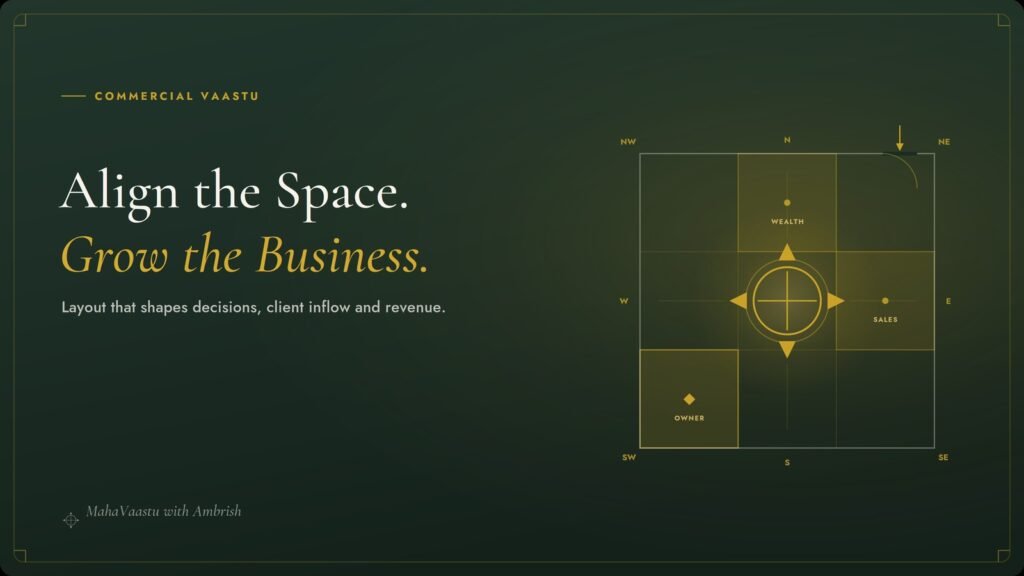
Business Vaastu: A Complete Guide to Office Layout, Growth and Profitability
Your workspace is doing more than housing your team. It is shaping decisions, client inflow and revenue every single day. Here is how to align it.
A business environment is not just physical, it is energetic. The way your office is structured speaks to your team and your visitors long before a single word is exchanged, and in the practice of Business Vaastu it directly shapes decision-making, client inflow, revenue stability and your overall rate of growth. Get the layout right and the space quietly begins to work with you. Get it wrong and even a strong team can feel as though it is pushing uphill.
Why Your Office Layout Shapes the Business
Every premises sits within a field of directional energy. Vaastu Shastra, the classical Indian science of architecture, maps that field across eight directions and gives each one a quality: the north-east for clarity, the south-west for stability, the east for visibility and growth, and so on. A commercial space is simply a container for human activity, and when an activity is placed in the direction that supports it, the work flows. When it is placed against its natural direction, the friction shows up in familiar ways, as slow decisions, stalled deals, money that arrives but does not stay, and a team that tires more quickly than it should.
This is why two businesses with similar products, similar budgets and similar talent can perform so differently. One has its leadership, its money and its client-facing functions sitting in directions that reinforce them. The other has them scattered, or worse, placed in zones that quietly undermine them. Business Vaastu is the practice of reading your floor plan against these directional qualities and correcting whatever is working against you.
The essentialsKey Business Vaastu Principles
A handful of placements do most of the heavy lifting. Before any detailed assessment, these are the ones that matter most in almost every commercial space.
Owner’s Cabin in the South-West
The south-west is the zone of weight, control and stability. Seating the owner or managing director here gives leadership a firm base, steadier judgement and lasting authority over the business. It is the anchor the rest of the office is built around.
Main Entrance in the North or East
The north and east invite opportunity, fresh enquiries and growth. A main entrance opening to either direction draws in new clients and momentum. Keep it bright, clean and unobstructed so that energy, and business, can enter freely.
Accounts in the North or South-East
Money is governed by the north, the direction of Kubera, the lord of wealth. The south-east, the zone of fire, supports the active energy of cash flow. Placing the accounts function in either direction helps revenue accumulate rather than drain away.
Sales in the East
The east is the direction of the rising sun, of visibility and expansion. A sales team seated here tends to be more energetic, more persuasive and quicker to convert. It is the natural home for the people who bring growth through the door.
A Clear, Open North-East
The north-east carries the lightest, clearest energy in the building. Keep it open, well-lit and free of heavy storage or toilets. A clean north-east sharpens thinking at the top and keeps the whole organisation’s sense of direction clear.
An Uncluttered Centre
The centre of any space, the Brahmasthan, is its energetic core. Leaving it open and free of heavy furniture, stacked files or clusters of equipment lets the whole office breathe and keeps activity circulating well.
Why Seating and Facing Direction Matter
Placement is only half of it. The direction a person faces while they work shapes how they think and perform, hour after hour. In Business Vaastu, the facing direction of your key people is treated with as much care as the room they sit in.
- The business owner should face north or east while working. North draws the energy of wealth and steady gains, while east supports clarity, growth and good decisions.
- Avoid seating employees so that they face south for long hours. Sustained south-facing work tends to feel draining and is best kept to short stretches rather than full days.
- Keep departments in the zones that support their work: sales in the east, the CEO toward the north, and the owner or managing director in the south-west, with each function aligned to the direction that strengthens it.
- Avoid seating anyone with their back to a main door or a sharp corner. A solid wall behind the chair gives a sense of support and protects focus.
When a workspace stops working against the people inside it, growth stops feeling like a fight.
What Changed for a Business in Vadodara
Principles are easiest to trust when you see them work. Here is a recent example from a company in Vadodara, shared without identifying details.
When we were first called in, the business was busy but stuck. Enquiries were arriving, yet too few were converting, and growth had flattened despite the team’s effort.
The plan told the story. The main entrance opened from the south-east, a fire-dominant direction that can stir friction at the very point clients walk in. Toilets sat in the north and the south-east, draining two of the most important zones for wealth and momentum. The team seating ignored hierarchy, with people placed wherever a desk happened to fit, and the drivers’ room occupied the south-west, the very corner that should anchor the owner and the leadership of the business.
We restructured the space around its directions. The entrance and circulation were reworked so opportunity could enter cleanly, the wealth zones were freed of their drains, the south-west was returned to leadership, and each team was reseated in the zone that supported its work. Within four months the business had grown threefold, conversion rates had improved noticeably, and clients had begun recommending the company of their own accord. The space had stopped working against them.
Common Commercial Vaastu Mistakes
Most commercial spaces are not undermined by anything dramatic. They are held back by a few avoidable placements that repeat across offices, shops and factories alike. These are the ones we see most often.
Toilets in Wealth Zones
A toilet placed in the north, north-east or south-east sits directly on a zone tied to wealth, clarity or cash flow, and quietly drains it. It is one of the most common reasons a profitable-looking business struggles to hold on to what it earns.
Random Seating Without Hierarchy
When people are seated wherever a desk fits rather than by role and direction, authority blurs and decisions slow. A clear seating order, with leadership anchored and teams in their zones, restores both structure and pace.
Dark or Blocked Entrances
A main entrance that is dim, cluttered or obstructed chokes the flow of opportunity at the threshold. Light, clear and welcoming entrances let new clients and fresh business move in without resistance.
Store or Server Room in the Wrong Direction
Heavy storage and server rooms carry weight and heat, and placed in the wrong zone, such as the north-east, they suppress energy that should stay light. Positioned correctly, usually toward the south or south-west, they add stability instead of blocking flow.
How a Commercial Vaastu Assessment Works
Reading a single principle is straightforward. Reading a whole premises, with its entrances, its existing walls, its team and its goals, is where experience matters. A proper commercial Vaastu assessment looks at the building as one connected system rather than a list of separate fixes.
- A directional study of the full plan, mapping every function against the zone that supports it.
- Targeted, goal-led corrections that are designed to avoid demolition wherever possible, so most changes are repositioning, colour and placement rather than construction.
- A seating and facing plan for leadership and for each department.
- Clear priorities, so you know which corrections will move the needle first.
If you are choosing or fitting out a new office, a layout assessment before you commit catches problems while they are still easy to fix on paper. And if you simply want to understand your own space first, the free Vaastu tools are a useful place to begin. For a closer look at why the money corners matter so much, see our guide to protecting the wealth zones of your space.
Frequently Asked Questions
Does Business Vaastu really affect profitability?
It works indirectly but measurably. Vaastu does not replace a good product or a capable team, but by aligning leadership, money and client-facing functions with the directions that support them, it removes the friction that slows decisions, deals and cash flow. Over time, that tends to mean a business converts and retains more of what it earns. Every space is different, so the gains vary, but the pattern is consistent.
Can I correct my office without major construction?
In most cases, yes. The majority of commercial corrections are repositioning, decluttering, colour and the right placement of furniture and functions, all designed to avoid demolition wherever possible. Structural changes are the exception rather than the rule, and when a particular building does need one, you will know up front.
Which direction should the business owner sit and face?
The owner or managing director is best anchored in the south-west, the zone of stability and control, while facing north or east during work. North draws the energy of wealth, and east supports clarity and growth. Together, the placement and the facing give leadership a steady base and a forward-looking outlook.
We are in a rented office. Does Vaastu still apply?
Yes. Direction does not change with ownership, so the same principles apply, and they work in most rented spaces. Since you may not be able to alter the structure, the focus shifts to seating, facing, the placement of functions, lighting and colour, which is where much of the benefit comes from in any case.
How quickly can results show?
It varies with the space, the corrections and the business itself. Some changes, such as reseating leadership or clearing a blocked entrance, can shift the feel of an office quickly, while compounding gains in conversion and revenue build over the following months. The Vadodara example above grew threefold within four months, though every business and every premises is different.
A commercial Vaastu assessment shows you exactly which corrections will strengthen decisions, client inflow and revenue, in the order that matters most.
Explore Commercial Vaastu or book a discovery call